
In 2022, the up-and-coming pop singer Jax made her first hit off a retail store every woman in America knows. “I know Victoria’s Secret,” she trills in the chorus, “she was made up by a dude!”
This radio-friendly allusion to one of America’s most recognizable lingerie brands is more of a half-truth. It’s true that the heyday of Victoria’s Secret—a time of ultra push-up bras, darkly-lit stores, and models known as “angels”—was ruled by controversy-courting CEO Les Wexner and chief marketing officer Ed Razek. It’s also true that behind the scenes, high-ranking women at the company tried to craft Victoria’s Secret in their image. They just didn’t always succeed.
Female executives are a surprise presence in Selling Sexy: Victoria’s Secret and the Unraveling of an American Icon, a new book charting the brand’s rise, fall, and influence on American retail. While the book digs into headline-grabbing topics like the brand’s earliest iterations of the Victoria’s Secret Fashion Show and devotes a chapter to Wexner’s ties to the sex trafficker Jefferey Epstein, it’s the quiet but purposeful presence of women in the background that struck me most as a reader. The initial catalog business and series of San Francisco boutiques were created by a wife-and-husband team, Gaye Raymond and Roy Raymond. These businesses were eventually acquired by Wexner’s L Brands group, along with the first fictitious persona, Victoria, around whom the brand would revolve.

Gisele Bündchen walks the runway at the 2006 Victoria’s Secret Fashion Show while Justin Timberlake performs.
(Image credit: Getty Images)
The famed VS catalog was led by a woman named Cynthia Fedus-Fields from the mid-’80s until 2000, while the store’s division had executive Grace Nichols’s direction between 1991 and 2007. Their contributions and opinions were just a few of the many that could get overshadowed by the demands of their male bosses. Where women saw lingerie as a potential tool for empowerment, the highest echelons of leadership saw it ultimately as their own kind of fantasy brought to life. (Per a 1985 interview with Wexner quoted in the book, “We’re selling hope in a bottle.”) It’s hard, at times, to square what the brand ultimately presented to the world with the aspirations of the people who actually worked there.

Tyra Banks walks the 10th anniversary Victoria’s Secret Fashion Show runway in 2005. She’s returning to the 2024 runway on Oct. 15.
(Image credit: Getty Images)
Authors Lauren Sherman and Chantal Fernandez didn’t anticipate finding so many women shaping Victoria’s Secret behind the scenes. Once they started reporting, they quickly discovered that some of its key figures turned to roles at the brand instead of the careers otherwise available to women at the time—mainly, teaching and nursing. As Victoria’s Secret’s influence grew in the 1970s and ’80s, “It was also a moment of women’s careers shifting, and a lot of women were greatly enriched by working at Victoria’s Secret,” says Fernandez.
“I think fashion and retail was an industry where women were able to advance more quickly because of the connection with the customer,” Sherman says. “And Wexner, despite his shortcomings, he trusted and promoted a lot of women in his business.”

Selling Sexy: Victoria’s Secret and the Unraveling of an American Icon authors Lauren Sherman and Chantal Fernandez.
(Image credit: James Magnifico )

Selling Sexy: Victoria’s Secret and the Unraveling of an American Icon
Shining a light on this fact is one of the many nuances the reporting duo, who met working together at Business of Fashion, wanted to highlight in the brand’s history. Victoria’s Secret undoubtedly had its flaws and its detrimental impacts on culture. Sherman and Fernandez’s reporting leaves no stone in the path to Victoria’s Secret’s eventual fall unturned, including its mistreatment of models and the backlash to its sexed-up imagery in the mid-2000s. Within that, the pair also wanted to paint a fair portrait of all actors that made the brand what it’s known as now. “The way the business press talks about companies is very black and white,” Sherman explains. “A lot of the coverage around Victoria’s Secret has been reduced to, essentially, sex and misogyny, but it’s way more complicated than that.”
She notes that “the consumer loved it for a time.” At its height, the Victoria’s Secret Fashion Show reached 12.4 million viewers on primetime television; pre- and post-fall, it had the largest share of the U.S. lingerie market.

Models attend the casting call for the 2024 Victoria’s Secret Fashion Show.
(Image credit: Getty Images)
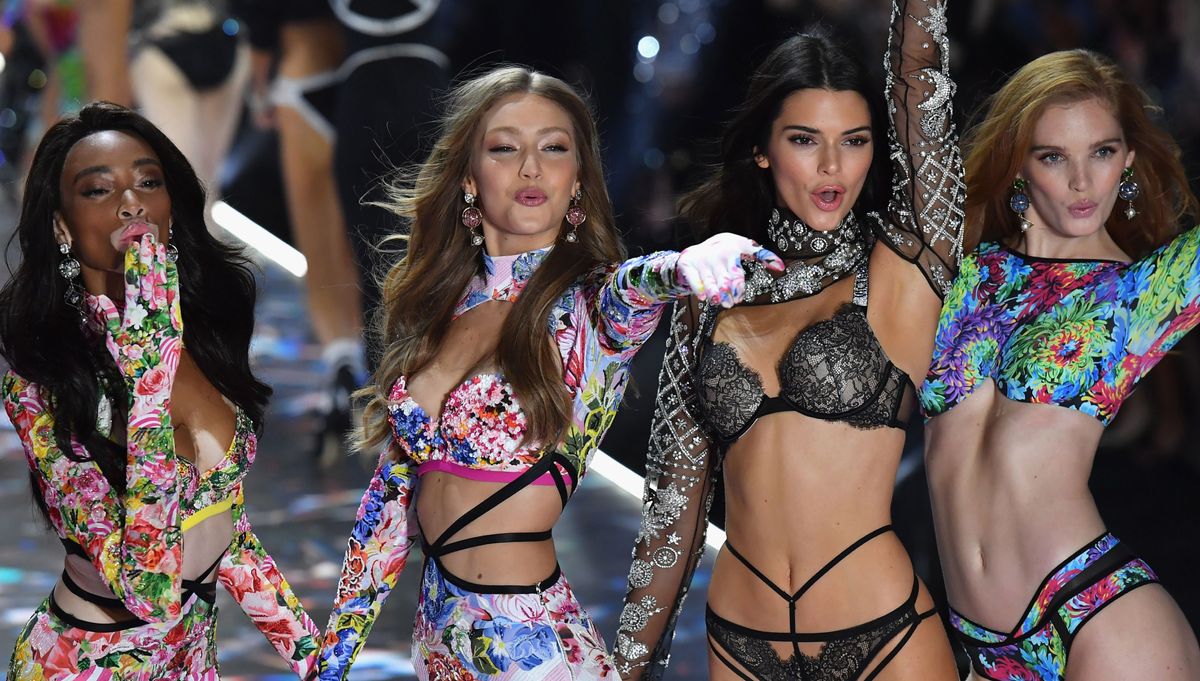
The brand has lost a lot of its late-’90s and early-2000s sparkle, as Selling Sexy chronicles. Fernandez notes that it’s lost a lot of cultural cachet to the likes of Skims, a brand that understands how to leverage celebrity while also being inclusive. But the Columbus, Ohio, based-retailer is ready to prove whether it’s learned from its own history. Tonight, the Victoria’s Secret Fashion Show is returning in an approximation of its original form, with a glitter-lined runway and angel wings. It’s also set to be more inclusive than eras past: For the first time, plus-size and transgender models will walk the runway with OG Angels like Tyra Banks and Candice Swanepoel. The show’s revamp is the first major move under the leadership of Hillary Super, the current CEO named in August.
A return to the catwalk was already in the cards before Super joined from Savage x Fenty. But it’s hard not to hope that fresh female leadership at the very top of the brand will course-correct for all the times women’s voices weren’t heard. Either way, Fernandez and Sherman will be watching.
link