
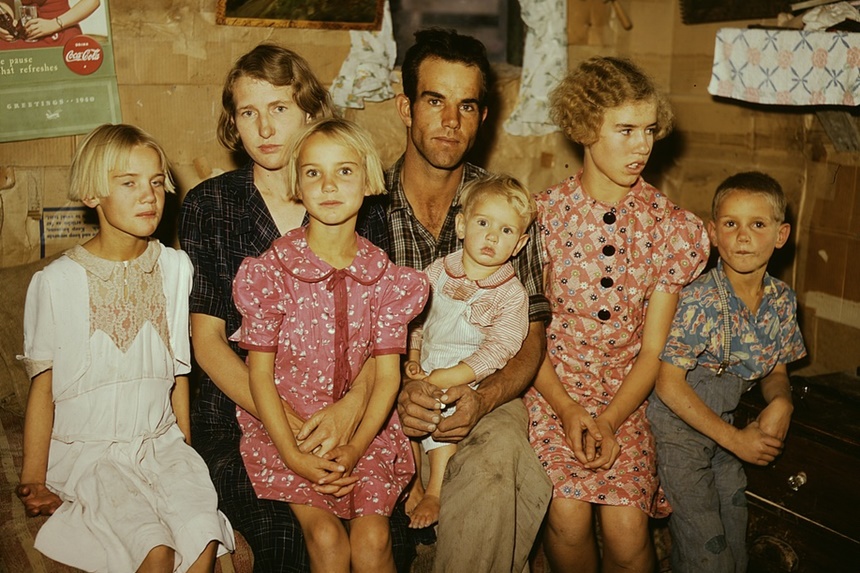
With the growing awareness of fashion’s environmental impact in recent years, we see the return of DIY movements and the rise of home sewing. Fused with nostalgia, this new trend, also called Cottagecore, celebrates a simple life adorned with prairie dresses and colorful prints.
This trend has roots going back into the early twentieth century, when rural America had far less access to the conveniences of modern life and the pace of consumer culture.
Indeed, during the Great Depression, the idea of reduce-reuse-recycle was not just an environmentally minded consumer choice, but a necessity for millions of people who found themselves impoverished and unemployed. At the height of the economic crisis, nearly one out of four people was out of a job, and farmers could not afford to harvest their crops, leaving them to rot.
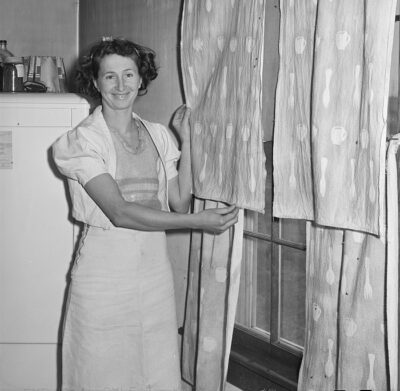
The fashion industry, like other sectors of the economy, also suffered from the economic downturn, as consumption of clothing, accessories, and jewelry plummeted from $11.2 billion in 1929 to $5.4 billion in 1933. As families refrained from buying new clothes, they instead focused on the durability and practicality of their existing wardrobes.
Yet, the inability to buy new clothes did not stop the urge to keep up with the fashions. Especially in rural areas, where even before the Depression economic hardship called for creativity, women turned to home sewing and whatever disposable resources they could find to clothe their families in style.

For many women living on farms, “creative recycling” was a way of life. Although by the early twentieth century many rural folks could take part in the burgeoning consumer market by buying goods through mail order catalogs like Sears, Roebuck, & Co., life on farms also demanded resourcefulness with the materials available. When fabrics and cash were scarce, rural housewives turned to feed sacks, often made from rough cotton fabric called osnaburg, to make towels, curtains, underwear, and sometimes even dresses.
By the 1920s, feed companies realized that they could increase their business by appealing not only to the farmer but also to his wife, and began marketing their sacks in multiple shades and patterns. In 1925, the new Gingham Girl Flour was packaged in a fine-quality red and white checked fabric, appealing to “eager housewives” who transformed it to fashionable dresses.
Making clothes out of feed sacks was a matter of economic need, and oftentimes a mark of poverty. Women tried to hide their dresses’ origins by soaking off company’s logos, dying fabrics, and adding ribbons and other decorative elements, making them look more like “store bought” clothes.
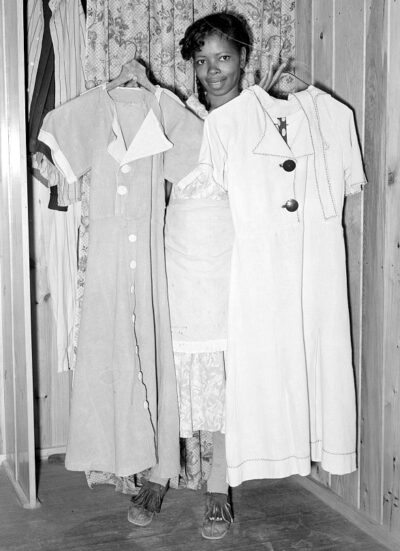
With the onset of the Great Depression, however, feed sack dresses lost much of their stigma. As the high fashion industry also began to adopt ideas of thriftiness and practicality, the economical solution of the sack dresses proved to be fashionable and appealing. No longer associated with backwardness or with poverty, sack dresses were now marketed as patriotic and stylish.
Feed companies began to compete over women’s tastes, increasing their print offering and making logos and stiches easier to remove. In 1933, the Textile Bag Manufacturers Association began issuing Sewing with Cotton Bags, a booklet which offered housewives patterns to make the latest trends. By 1937, its circulation reached 318,000 individuals, home economic classes, 4-H clubs, and WPA programs. Other companies, like the National Oats Company of Cedar Rapids, Iowa, sponsored fashion shows and sewing contests for the best designs out of feed sacks.

Flour and Seed companies capitalized on their new role as the nation’s supplier of fashionable clothes. Richard Peek, the Vice President of Kansas City’s Percy Kent Bag Company was crowned by Time magazine as the “Hattie Carnegie of sack fashions.” Although some salesmen lamented that the decision which grains to buy was no longer based on the farmer’s needs but on his wife’s fashionable aspirations, women welcomed this new status as well as the shared decision-making power they were granted.

With U.S entry into World War II, mill and seed companies shifted their attention to war mobilization and meeting the military needs. By July 1942, War Production Order No. L-99 and L-85 further put restrictions on cotton production for both clothing and sacks. Yet, despite fears of sack shortages, women continued reusing the printed feed sacks to make their garments. Shifting the emphasis on thriftiness from economic recovery to patriotic duty, the making of sack dresses and women’s dexterity were now framed as part of the homefront contribution to the war effort.

The end of the war and the economic prosperity of the 1950s lessened both the necessity and popularity of sack dresses, even though they remained prevalent in rural areas well into the 1960s. Instead of “making-do” with available resources, housewives preferred to utilize their power as consumers to claim a more active role on households and farms.
If today we think of sack dresses as a romantic relic of the past, their history shows us that far from being a precursor to environmental-minded trends from the coasts, the popularity of sack dresses in the 1930s and 1940s made the rural women of heartland America part of the national fashion system and trend influencers on their own merit.
Become a Saturday Evening Post member and enjoy unlimited access.
Subscribe now
link