


The results are structured as follows: first, a comparative study of female fashion from the 16th and 17th centuries, based on selected paintings, applied to the dress of the Virgin of the Rosary. This is followed by a comparative analysis of the cut and colour of the gemstones represented in the paintings and those present in the Virgin sculpture and their location. Subsequently, the chemical and mineralogical characterization of the gemstones in the Virgin’s dress is presented. Finally, the last two sections address the study of the dropped gemstones through optical examination and SEM-EDS characterization.
Comparison study of clothing
The comparative study of the clothing of the Virgin and the paintings analysed shows that all the figures wear a wide skirt with a jubón (doublet) and a basquiña (overskirt), which appear as two cones facing each other (red line in Fig. 4), forming the truncated-cone shape.

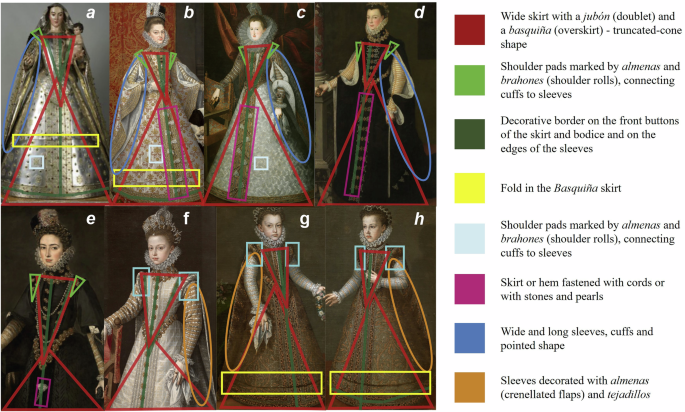
a Virgen del Rosario, Archconfraternity of the Holy Rosary of Granada, © IAPH; b Infanta Isabel Clara Eugenia and Magdalena Ruiz, oil on canvas 1585–1588 by Sánchez Coello; c Margaret of Austria, oil on canvas 1606 by Pantoja de la Cruz; d Elisabeth of Valois holding a portrait of Philip II, oil on canvas, 1561–1565 by Anguissola; e Infanta Catalina Micaela, oil on canvas, Ca. 1584 by Sánchez Coello; f Infanta Isabel Clara Eugenia, oil on canvas, 1577 by Sánchez Coello; g, h Infantas Isabel Clara Eugenia and Catalina Micaela, detail of oil on canvas, 1575 by Sánchez Coello. ©Archivo Fotográfico del Museo Nacional del Prado.
The Virgin (Fig. 4a) has a bodice fitted to the waist with a pointed bottom edge and a truncated cone edge. The sleeves are wide and fall to the ground, revealing the cuffs, which are also made of silver and are finished with natural fabric lace. The shoulder pad marks the junction between the torso and the arm. Gemstones border the front buttons of the bodice and skirt and the edges of the sleeves along with stones set symmetrically in stars and monograms representing the Virgin and Christ, imitating embroidery on fabrics.
This outfit aligns with the characteristics of the 16th–17th century women’s fashion observed in the court portraits, as they all (Fig. 4) feature marked profiles that accentuate verticality thanks to the decorative border on the front buttons of the skirt and bodice and on the edges of the sleeves (dark green line). The skirt or hem is fastened with cords or with stones and pearls (pink line in Fig. 4c–e). The basquiña shown in Fig. 4 (a, b, g, and h) features a fold in the skirt that can be loosened when sitting, ensuring the garment still covers the feet and shoes (yellow line). The wide, long sleeves (blue line) reveal the cuffs and vary in shape: pointed (Fig. 4a–d), round and wide (Fig. 4e), jacket-style or loose, sewn halfway up (“a la turca”), and decorated with almenas (crenellated flaps) and tejadillos (orange line). This style, common for children due to its comfort, appears in Fig. 4f–h. All depictions show cuffs embroidered with gold trim and collars with ruffles.
The truncated conical silhouette remains consistent, with jewels sewn onto the clothing emphasizing construction lines (dark green lines). Shoulder pads are marked by almenas and brahones (shoulder rolls), connecting cuffs to sleeves (light green and turquoise lines). Symmetrical embroidered motifs appear on the fabrics (light blue line), while on the Virgin, metal motifs with set stones imitate embroidery (Fig. 4a).
This 16-17th-century women’s fashion in the Spanish court is characterised by the decorum of the queens and princesses of the House of Austria as, through the refinement of their dresses, women represent the moderation of their manners and their religious customs—a new concept of femininity, which reflects the Christian ideology of the institution they represent20. As a result, the image of the queens and princesses acts as propaganda and a representation of the spirit at the court of Philip II. The farthingale, the cardboard chest, the chapines and the guardapiés erased the feminine forms and covered the whole body, as well as giving height and establishing a physical and symbolic distance from the rest of the court and the common people. This silhouette was magnified with the jewels that they wore sewn to their dresses, giving them a grand and solemn appearance.
This fashion was transmitted through the royal family’s practice of donating their own dresses to be used to clothe images of the Virgin. Notable examples include Elisabeth of Valois’s 1569 gift of a skirt embroidered with garnets, green stones, and enamelled gold buttons to the Monastery of San Clemente el Real in Toledo for an image of the Virgin with Child; Isabel Clara Eugenia’s 1598 donation of a skirt embroidered with gold, silver, and garnets; and queen Margaret of Austria’s gift of a skirt to the Virgen de la Caridad of Illescas21.
Cut and colour comparison
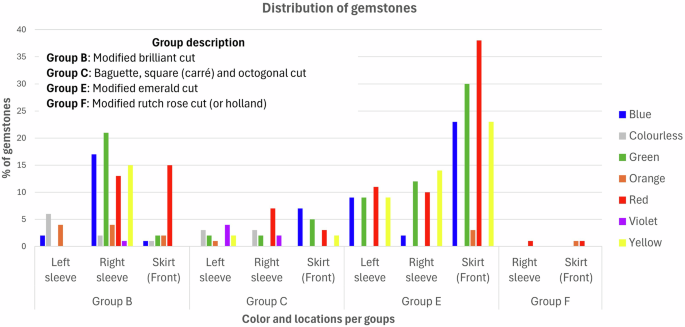
A total of 1634 gemstones were studied in the paintings (Table 2). Of these, 1592 were black, while 2.6% (42) were red. Black gemstones depicted in the paintings may represent diamonds. According to Arfe22, yellow and blue diamonds were considered less valuable than grey and transparent ones in the 17th century and, because of that, diamonds were dyed black on the reverse to achieve a steel-grey effect.
Red is the most common gemstone colour in depictions of the Virgin sculpture (30%), while it is the second most represented colour in paintings (2.6%). The colour red has been related to royalty since the antiquity23.
More than 85% of the analysed gemstones of the Virgin are mounted on their table, with the pavilion exposed, contrary to the usual mounting observed in paintings representing jewellery in the 16th–17th centuries, where 87% of the gemstones were mounted on the crown. This mounting may have been selected due to the greater stability it offered the gemstone, placed on the largest facet, or the result of the lapidarist’s aesthetic criteria. All gemstones featured on the Virgin present a bezel setting, as with most of the gemstones observed in painting (42%).
Most of the gemstones featured on the Virgin are emerald cut (≃80%/Group E), while 78% presented a table cut in the painting, which may be associated with group C (<10%). Rose cuts are scarcely present in both cases.
The observed differences could point to the possibility of later modifications made to the gemstones incorporated in the dress.
Chemical and mineralogical characterisation of the virgin gemstones
The four groups of gemstones (B, C, E and F), classified according to their cut, present different compositions identified by XRF, Raman and FTIR that depend on cut and colour (Table 3).
Group B
Red and green gemstones with modified brilliant cut are mostly quartzes. In contrast, the analysis of the blue stones was limited due to their placement on the garment, allowing only one to be examined, which was identified by Raman spectroscopy as a blue glass imitation (Fig. 5, Table 3). The Raman spectra for quartz gemstones (red and green colours) are consistent with those reported by several authors5,8,9,11,24. Some red and green coloured gemstones are quartz composites in which a paste has been used to give colour, which is commonly degraded, presenting a colourless quartz. Figure 6c shows the Raman spectrum of quartz detected in a green gemstone with an advanced state of alteration.

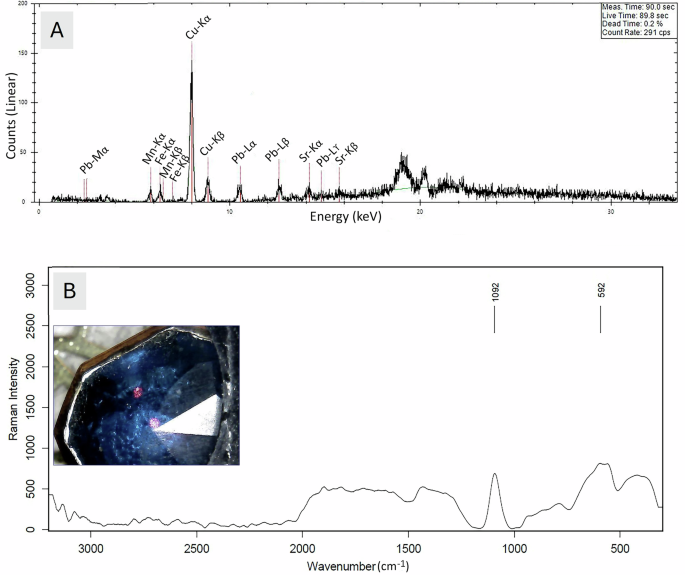
A XRF spectrum showing the presence of copper as the main chromophore; B Raman spectrum displaying broad bands characteristic of glass nature.

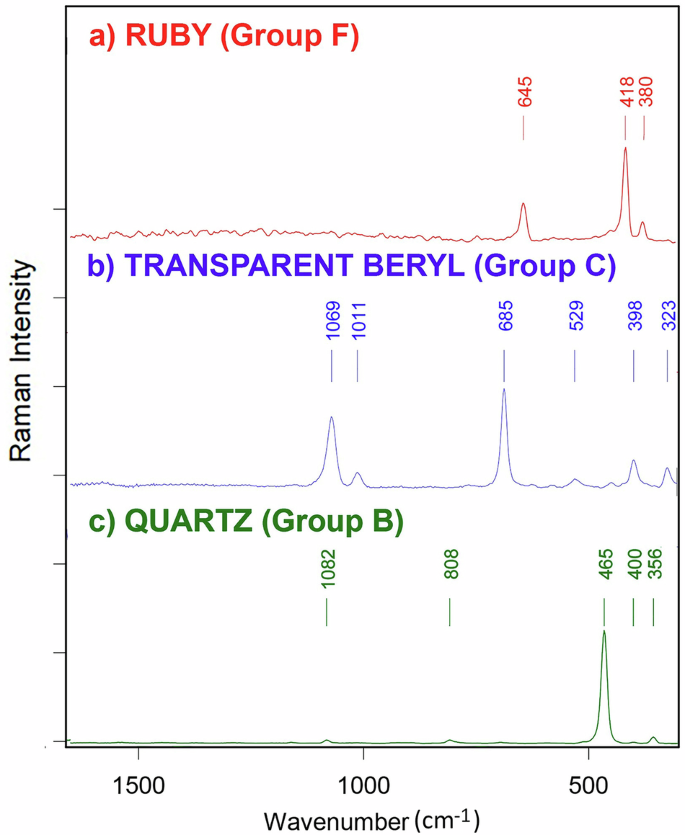
The Raman spectra of a ruby (red variety of corundum), b transparent beryl (goshenite) and c quartz.
XRF analyses indicate that the blue glasses contain copper as the main chromophore element, as shown in Fig. 5. These results are consistent with those reported by other authors for historical glasses, where copper has been identified as the only blue colouring agent in soda-lime and lead-rich glass pieces25, or in combination with cobalt to achieve different tonalities26. Additionally, iron was detected in one of the red coloured composite quartz stones, commonly associated as an impurity element in quartz27.
Group C
Colourless, red, violet, yellow and green gemstones with baguette, carré or octagonal emerald cut with the crown visible. In this group, quartz, coloured glass, beryl and corundum were found.
The transparent gemstones in group C are mostly rock crystal (colourless quartz), except for one identified as transparent beryl (goshenite) (Fig. 6). The red stones in this group include several quartz composites in which the colour is provided by a red coloured paste, some of which show signs of alteration. In addition, one red gemstone was identified as corundum with emerald cut in crown (ruby), according to Raman and FTIR spectroscopy (Table 3). The obtained Raman spectra align well with values reported in the literature8,11,16,24, confirming the presence of quartz, beryl, and corundum gemstones in this group.
The yellow stones are coloured glasses, according to the broad bands observed in their Raman spectra and further supported by FTIR analysis (Fig. 7, Table 3)10,16,28,29. The main chromophore contributing to the yellow colour is lead (Pb) while the presence of copper (Cu) may contribute to a more greenish hue.

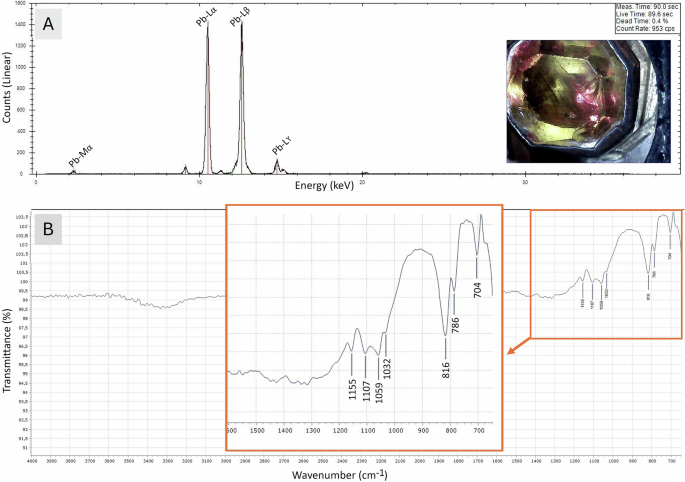
A XRF spectrum showing the presence of lead as the chromophore element; B FTIR spectrum display bands associated with the vitreous nature of the piece.
The violet glass imitations analysed in this group are characterised by the presence of iron (Fe), manganese (Mn) and copper (Cu) as chromophores. According to previous studies on historical glass30, Mn3+ is responsible for producing an intense violet colouration that can dominate over other chromophore contributions, such as iron and copper elements, which could introduce small variations in the hue. Raman spectra of these pieces show broad bands or low-intensity signals, with no clear evidence of crystalline phases, which is consistent with the hypothesis that these are coloured glass materials.
In addition, the presence of cobalt (Co) has also been found in the blue stone and copper (Cu) in the green stone.
Group E
Red, blue, yellow and green stones with modified emerald cut show broad Raman bands which may be indicative of an amorphous structure28,31. These Raman spectra do not exhibit the sharp features typical of crystalline phases and are therefore consistent with glasses, as shown in Table 310,28,29,32.
Yellow glass imitations studied by XRF show two types of chromophores: (1) lead (Pb), used since ancient times, where glass have small aggregations of lead oxide33; and (2) arsenic (As), where an arsenic sulphide compound may be responsible for the colour13,34.
The blue glass imitations present two types of chromophores: (1) copper (Cu) associated to Cu2+ as the main chromophore element25; and (2) iron (Fe), associated to Fe2+ 30.
All the red glass imitations are associated to CdS+CdSe (cadmium red) as chromophores. Although cadmium-based compounds began to be commercialised after 1840, their widespread use as colouring agents in glass became common by the 1920s35. Later, in 1977, Wagner patented an industrial process for producing firing-stable yellow to red glaze mixtures based on cadmium pigments36. This evidence suggests that all these stones were replaced from the beginning of the 20th century onwards.
Finally, all the green glass imitations contain copper and iron as chromophore, probably added to the base glass to obtain the green colour14.
While most of the pieces studied in this cut group have a glass nature, there is a violet gemstone identified as amethyst (quartz, violet variety), according to the Raman spectrum (Table 3). This feature may suggest a replacement that occurred after the artwork’s creation but non-contemporary with the employment of glasses.
Group F
Red and orange gemstones with modified dutch cut. Two orange gemstones have been identified as citrine (a variety of quartz). Meanwhile, the red modified Dutch gemstone has been identified as ruby (red corundum).
The Raman spectrum of ruby (red corundum) is shown in Fig. 6a, while the characteristic bands obtained in the Raman analysis are listed in Table 3 in agreement with reference values24,37,38.
Optical study
Optical study was carried out on dropped gemstones. Violet and colourless gemstones were anisotropic, uniaxial and with refraction indexes similar to amethysts and smoky quartzes, according to the results obtained by Raman and FTIR spectroscopy. These gemstones also showed small bubbles and solid inclusions. The yellowish piece was identified as citrine quartz, while a red gemstone with emerald cut showed anisotropic behaviour with polarised light and refraction indexes like corundom. This latter gemstone also presented light fluorescence with ultraviolet light. The colour of this ruby is due to chrome (Cr), according to the doublet observed in the absorbance spectra, though this was not detected by XRF.
Green and blue pieces with emerald cuts mounted on their table were isotropic with a refraction index ≃1.500, whereas the other red piece presented a refraction index of 1.788, due to a different chemical composition. In both cases, these values are consistent with glasses and vary according to their composition.
SEM-EDS analyses
The SEM-EDS analyses were carried out on dropped gemstones with a suitable size and geometry to avoid dispersion of the electron beam (Table 4).
Amethysts (quartz) presented high silica content (G2, G4 & G7), while the three step-cut gemstones showed a chemical composition similar to glass (Table 4). The green and violet gemstones were soda-lime silicate glasses with a high content of SiO2 (A1 and G1); while the red gemstone was a lead silicate glass (G9). The high content of lead in this latter gemstone induced a higher refraction index. The addition of lead to glass makes it easier to carve and increases its shine, improving the quality of the synthetic gemstone. While glasses from the ancient (Mesopotamian, Egyptian or Roman) period are usually soda-lime silicate glasses with a high content of impurities due to the low purification of raw materials39,40, with the development of better melting furnaces, higher temperatures could be reached for long periods of time, facilitating the melting of glasses with higher silica content41. Glasses with a high content of lead have been found in Spain since Roman times42,43. These glasses were brighter, easier to cut and engrave, and presented lower melting temperatures than the soda-lime silicate glass, though they were also more fragile and heavier44.
link